
(Scan code for SpiritAndTruth.org)
© 2003 www.SpiritAndTruth.org1
Prayer
Purpose of Today’s Class: to understand...
[Show schedule,
timeline]
..\01_the_mystery_of_the_jews\israel_02_01_schedule.doc
..\01_the_mystery_of_the_jews\israel_02_01_timeline.doc
The revelation of God to the Gentile nations through Israel (Eze. 39:27).
The revelation of God to Israel through supernatural intervention (Eze. 39:7, 22, 28).
“The display of God’s glory and judgment is linked with the restoration of Israel to a right relation with their Maker ( Ezk 39:25–29 ).”2
The revelation of God to the Gentile nations through supernatural intervention (Eze. 38:16, 23; 39:21).
The sovereignty of God, especially in regard to controlling Gog (Eze. 38:4, 10, 16; 39:2).
An illustration of the potential danger for any nation which stands in opposition to God’s work of restoring Israel (Isa. 29:5-8).
A Word of Caution about Prophetic Teaching
The “cake” vs. “frosting” analogy
Many teachers you will hear today on prophetic issues are going beyond the scriptures.
The temptation: popularity, ‘insider knowledge,’ and itching ears of the sheep.
Serving up ‘cake’ (God’s Word), but with a thin layer of ‘frosting’ on top (their own interpretation or spin).
The frosting makes the cake sweeter to the taste…
But they aren’t clear about where the cake ends and the frosting begins.
Such teaching becomes dated very quickly. Just listen to their tapes from a year or more ago. Why? Because it is based more on opinion and less on the statements of scripture.
If God’s Word regarding these prophecies has been relevant for over 2000 years, ask yourself why these teachers have to keep ‘updating’ their teaching every 6-12 months?
The tendency to want to fit all prophetic scripture into our own era.
The antidote: let God manage HIS-story!
Hab 2:2 Then the
LORD answered me and said: "Write the vision And make [it]
plain on tablets, That he may run who reads it. For the vision
[is] yet for an appointed time; But at the end it will speak, and
it will not lie. Though it tarries, wait for it; Because it will
surely come, It will not tarry.”
A Word about Prophetic Imagery
Identifying Peoples and Nations in unfulfilled prophecy.
Example of Constantinople
Byzantium (657BC-330 AD)
Constantinople (330-1930),
Istanbul (1930-present)
Names of peoples or regions relate to the time at which the vision is given
In cases where fulfillment is yet future, the region or race correlating to the historic vision must be meant, even if the names have changed.
Otherwise, how could we have any chance of making sense of the details given?
Prophetic visions and Implements of War
"Some have ground great difficulty in the references to armor, buckler, shield, sword and helmet, but even in our day of advanced weapons of warfare it is interesting to learn that in some parts of the world conflict is going on with primitive weapons. (And how else could an ancient writer have described warfare? They knew nothing of planes and guns.)"3
The second coming of Christ as an example:
Re 19:11 Now I saw heaven opened, and behold, a white horse. And He who sat on him [was] called Faithful and True, and in righteousness He judges and makes war.
Re 19:14 And the armies in heaven, clothed in fine linen, white and clean, followed Him on white horses.
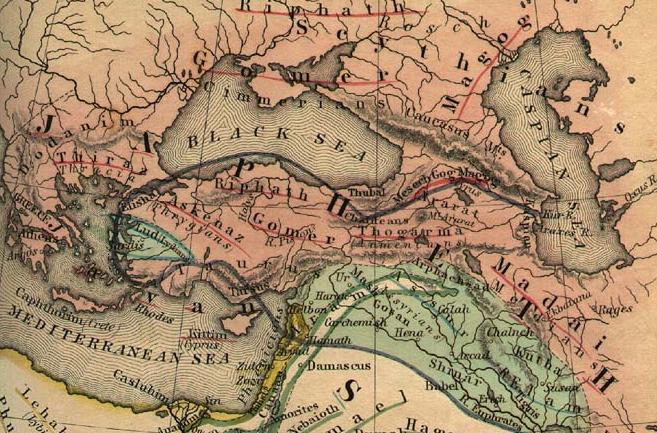
Identity of Participants
Map of region
israel_02_11_map.jpg
Gog: a title
A 7th-Century B.C. Lydian King?
“Various attempts have been made to explain the origin of the name Gog. Some scholars have looked for a historical figure as the source of the term. Among the many suggestions which have been proposed, the most convincing historical referent is the 7th-century b.c.e Lydian king Gyges. Other scholars have explained the name mythologically, derived from the Sumerian word for darkness or from the name of the Akkadian god Gaga.”4
“He has been identified with Gugu, known in his own land of Lydia as Gyges, and mentioned in the records of Ashurbanipal. The phonetic similarity is too uncertain for positive identification, however.”5
“Who Gog will be can only be determined at the time of the invasion for ‘Gog’ is not a proper name but a title for the ruler of Magog just as the terms pharaoh, Kaiser, and czar were titles for rulers and not proper names.”6
Russian connections?
“It has been supposed to be the name of a district in the wild north-east steppes of Central Asia, north of the Hindu-Kush, now a part of Turkestan, a region about 2,000 miles north-east of Nineveh.” 7
“the actual invasion of Palestine by a great northern confederacy, ostensibly headed by Russia. The scene depicts a gigantic outburst of anti-Semitism and a colossal attempt to overrun Palestine and annihilate the Jews. Russia and the northern powers have been persecutors of dispersed Israel, and it is consonant with the covenants and promises of Israel, which are yet to be fulfilled (cf. Gen. 15:18–21 ; Deut. 33 ), that divine destruction should be precipitated at the climax of the last attempt to destroy the remnant of Israel in Jerusalem and Palestine.”8
Russian identification questioned.
“The popular identification of Rosh with Russia, Meshech with Moscow and Tubal with Tobolsk in Siberia has nothing to commend it from the standpoint of hermeneutics, though some of the wilder Russian tribes would fit into the explanation given.”9
A symbolic name designating the enemy of Messiah?
“king of the locusts?”, Amos 7:1 and the Septuagint11
Am 7:1 Thus the Lord GOD showed me: Behold, He formed locust swarms at the beginning of the late crop; indeed [it was] the late crop after the king's mowings. (NKJV)
One of the four versions of the Septuagint translates Amos 7:1 as "Thus has the Lord God shewed me; and behold, a swarm of locusts coming from the east; and, behold, one caterpillar, king Gog." [Οὕτως ἔδειξέν μοι κύριος καὶ ἰδοὺ ἐπιγονὴ ἀκρίδων ἐρχομένη ἑωθινή, καὶ ἰδοὺ βροῦχος εἷς Γωγ ὁ βασιλεύς]12
Elsewhere, scripture records that normal locusts have no king. This lends credence to the possibility that Gog is understood in Amos 7:1 as the leader of a devouring horde, not a real insect.
Pr 30:27 The locusts have no king, Yet they all advance in ranks;
Other appearances of the name
“A Reubenite, descended from Joel ( 1 Chr 5:4 ). Gog is second in the list of the sons, or descendants, of Joel. The list may represent a line of Reubenite chieftains…. Apparently Gog was a member of the clans of seminomadic herdsmen who roamed the desert frontier E of Gilead, from Moab to the Euphrates”13
Magog: Scythians
“land of Magog” eretz ha-magog, אֶרֶץ הַמָּגוֹג
Some see the name itself as denoting land of Gog
“Magog
is probably equivalent to a phrase in the Akkadian language, mat
Gog (‘land of Gog’).”14
“Magog is one of the sons of Japheth, whose descendants occupied lands from Spain to Asia Minor, the islands of the Mediterranean to southern Russia. Some connect Magog with the Scythians.” 15
“Jerome stated that the Jews of his day held that Magog was a general designation for the numerous Scythian tribes.”16
“Josephus … said: ‘Magog founded those that from him were named Magogites, but who by the Greeks were called Scythians.”17
Scythia
“An ancient region of Eurasia extending from the mouth of the Danube River on the Black Sea to the territory east of the Aral Sea.”18 This would be north and east of Turkey and include parts of the Russian Federation, Kazakhstan and Uzbekistan.
Other appearances of the name
“One of the sons of Japheth according to Gen 10:2; 1 Chr 1:5.”19
Identity of Rosh
Russian connection?
the American Standard Version translates this expression, “the prince of Rosh” which some connect with the root consonants of the modern term “Russia.” They were an ancient people located to the north of Israel ( Ezek. 27:13 ; 32:26 ).20
the invaders, especially Gomer and Magog (vv. 2–3 ), invade the land from the “far north” (vv. 6 , 15 ; 39:2 ). The only nation that the description “far north” would fit would be Russia which, of course, is immediately to the north of Israel, with Moscow being directly north of Jerusalem. Though some attempt to question the identification, because Russia extends more than six thousand miles east and west any reference to a nation to the far north of Israel would have to be Russia because of the geographic facts involved.21
The phrase “from the extreme [side, extreme edge, border] north” (miyareketiy tsaphon, מִיַּרְכְּתֵי צָפוֹן) only appears in Ezekiel 38 and 39 and would imply a people further afield than Assyria. Certainly the people at the extreme north from the point of view of Israel would include a Russian contingent.
“Some expositors have taken this word as a reference to a country known as Rashu (or Reshu), an ancient land along the Tigris River often mentioned in the Assyrian Annals. Others have identified rōsh with a people known as the Rus who were connected with the Scythians and lived in the region of the Taurus Mountains in what is present-day Turkey. Some have associated the word with Russia, but this is accomplished only through resemblances in spelling or sound.”22
“Rosh was in what is now northern Russia. The name Rosh is the basis for the modern name Russia.”23
Non-Russian Identification
Rosh means “head” or “chief” (e.g., rosh Hashanah = “head of the year” or new year).
The “prince of Rosh, Meshech, and Tubal”
(NKJV, NASB)
or…
the “chief prince of
Meshech and Tubal” (AV, RSV, NET)
In support of the idea that Rosh means chief here, “it should be noted that Meshech and Tubal are coupled together, in secular as well as biblical writings ( 27:13 ; 32:26 ; Gen 10:2 ).” 24
“Should be translated ‘chief prince of Meshech and Tubal … ‘ because: 1) Rosh (more than 600 times) in the Heb. OT is an adjective, “chief,” often in references to the “chief priest” ( 2 Kin. 25:18 ); 2) most ancient versions took it to mean “chief “ or “head”; and 3) in all places other than chaps. 38 and 39 where both Meshech and Tubal are mentioned, Rosh is not listed as a third people ( 27:13 ; 32:26 ; Gen. 10:2 ; 1 Chr. 1:5 ).”25
“Gesenius suggested Russia, but this name is not attested in the area, and a very distant people named thus early is unlikely in the context. Most follow Delitzsch in identifying Rosh with Assyr. Rašu on the NW border of Elam ( i.e. in Media).”26
“May refer to a Lydian king in west Asia Minor in the seventh century b.c.”27
Other mentions
First mention, Gen. 46:21, as one of the sons of Benjamin, but probably unrelated in any significant way.
Meshech and Tubal: Russia or Turkey
“Some also point to the fact that Meshech has some similarity to the modern name of Moscow in its consonant structure, and Tubal is similar to one of the prominent provinces of Russia-Tobolsk.”28
“Meshech is to be identified with Mushke, which is located in northwest Asia Minor, not modern-day Russia’s Moscow. Also, there is no linguistic affinity between the terms.”29
“Meshech and Tubal are generally connected with people who were known to have lived in ancient Anatolia, modern Turkey. Thus, Tabal (Tubal) lay north of Cilicia in eastern Anatolia and Meshech names the ancient Mushki who lived in central Anatolia. Both kingdoms are known to have opposed the Assyrian forces of the eighth century b.c. The king of the Mushki, Mita, has been linked with the famous King Midas, whose touch turned everything to gold.”30
“Two peoples were recognized in ancient Assyrian monuments: one called Mushki (Mushku) and the other Tubali (Tabal). Both were in Asia Minor, the area of Magog, modern-day Turkey.”31
Tubal ( 38:2 ) was also mentioned as a son of Japheth ( Gen. 10:2 ; 1 Chron. 1:5 ). Though originally located south of the Holy Land area, they eventually went north and have been identified as the ancient Scythian tribe which at one time occupied Asia Minor.32
“Meshech and Tubal were between the Black and Caspian Seas which today is southern Russia. The tribes Meshech and Tubal later gave names to cities that today bear the names of Moscow, the capital, and Tobolsk, a major city in the Urals in Siberia. Rosh was in what is now northern Russia.”33
“Meshech and Tubal have been identified as Phrygia and Cappadocia. They appear to be the Moschi and Tibareni of the classical writers (see Gen. 10:2). They lived in the neighborhood of Magog.”34
Persia: Iran
Most commentators see this as the area of modern-day Iran.
Cush: Ethiopia or an area in Arabia.
“The identity of Cush (v. 5 ) is uncertain, but it has often been referred to as the area east of Egypt and west of the Red Sea.”35
“Ethiopia or Cush, being an Arabic nation contiguous to the northern powers”36;
“There were two places that had this name. One was in Mesopotamia (Genesis 2:13). But all other usages of this word refer to Ethiopia.”37
“This name is used in Scripture nine times, according to Young’s concordance, to refer to the area in Africa, and eleven times to refer to the land of Cush, a portion of Arabia.”38
Put: Libya… or south of Cush in Arabia
“The identity of Put (v. 5 ) also is uncertain, but some have placed it immediately south of Cush in Africa.”39
“Libya or Put being not the North African nation, but also an Arabic nation contiguous to the northern powers”40;
“Put is mentioned next which is not Libya for which the name Lub would be used, but Somaliland or Somalia. Somalia borders Ethiopia.”41
“Put may be located as adjacent to Persia or Iran.”42
Gomer: Germany or Armenia
“Gomer (v. 6 ) was usually associated with the ancient Cimmerians, some who were located in Asia Minor and others in Eastern Europe”43
“Gomer, being modern-day Germany” 44
“Gomer [is] located in present-day Germany, half of which is already under Russian domination.”45
“Today the area is Armenia, which also was known as Cappodocia, having a people called Gomer in Assyrian inscriptions.” 46
“The people of Gomer were the Cimmerians, a people from what is now southern Russia.” 47
“Valuable information is given in the Talmud; Gomer is there stated to be the Germani, the Germans. That the descendants of Gomer moved northward and established themselves in parts of Germany seems to be an established fact.”48
Togarmah: Armenia
Sheba – SW Arabia
“The kingdom of Sheba. The kingdom of the Sabeans (which see), which, according to some, embraced the greater part of the Yemen, or Arabia Felix. When the fame of Solomon came to the ears of the queen of Sheba (Saba), she undertook a journey to Jerusalem to convince herself of the truth of the report that had reached her. She proposed to test his wisdom by posing “difficult questions” ( 1 Kings 10:1–13 ; 2 Chron. 9:1–12 ). A large number of inscriptions have been found in SW Arabia written in the so-called Sabean characters.”52
Dedan – Located on the shores of the Persian Gulf
“The passages in the Bible in which Dedan is mentioned (besides the genealogies above referred to) are contained in the prophecies of Isaiah ( 21:13 ), Jeremiah ( 25:23 ; 49:8 ), and Ezekiel ( 25:13 ; 27:15 , 20 ; 38:13 ) and are in every case obscure. The probable inferences from these mentions of Dedan are (1) that Dedan, son of Raamah, settled on the shores of the Persian Gulf, and his descendants became caravan merchants between that coast and Palestine….”53
Tarshish – probably southern Spain
“Probably Tartessus, a city and emporium of the Phœnicians in the south of Spain, represented as one of the sons of Javan. Gen. 10:4 ; 1 Kings 10:22 ; 1 Chron. 1:7 ; Ps. 48:7 ; Isa. 2:16 ; Jer. 10:9 ; Ezek. 27:12 , 25 ; Jonah 1:3 ; 4:2 . The identity of the two places is rendered highly probable by the following circumstances: 1st. There is a very close similarity of name between them, Tartessus being merely Tarshish in the Aramaic form. 2d. There seems to have been a special relation between Tarshish and Tyre, as there was at one time between Tartessus and the Phœnicians. 3d. The articles which Tarshish is stated by the prophet Ezekiel, Ezek. 27:12 , to have supplied to Tyre are precisely such as we know, through classical writers, to have been productions of the Spanish peninsula. In regard to tin, the trade of Tarshish in this metal is peculiarly significant, and, taken in conjunction with similarity of name and other circumstances already mentioned, is reasonably conclusive as to its identity with Tartessus”54
“the Mediterranean itself was once known as the 'Sea of Tarshish'."55
the merchants of Tarshish and all their young lions
may refer to leaders
may refer to nations that have come out of Tarshish
“This phrase is a Hebrew idiom meaning nations that have come out of Tarshish. The Revised Standard Version translates the idiom as all its villages and is close to the mark.”56
If Tarshish is Spain, the young lions could be countries of Central and South America
If Tarshish is England, young lions could be USA, Canada, Australia, and other present-day western democracies. (Although the identification of Tarshish with England would seem to be tenuous at best.57)
“Tarshish has been identified with Great Britain, but not on good grounds.”58
Timing of the Conflict
History past?
“Those who have attempted to refer these chapters to specific conflicts in the past have arrived at widely different results. One view places it in the conflict of the Maccabees with Antiochus; another in the invasion and overflow of the Chaldeans; and still another in the temporary victories and final overthrow of the Turks. All these are equally unsatisfactory because the passage is clearly set in the future, in the time of Israel’s consummation.”59
The plain reading of the text precludes previous fulfillment. Moreover, the context indicates the restoration and spiritual awakening of Israel which has not yet occurred.
An important key:
“These seven months of burying
and seven years of burning are crucial in determining when
this invasion occurs. For any view to be correct it must satisfy
the requirements of these seven months and seven years.”60
Preconditions
“the latter years” or “latter days” (Eze. 38:8, 16)61
Israel gathered again (Eze. 38:8)
The invasion assumes
the reestablishment of a Jewish state. Prior to 1948, this
invasion would not have been possible.
the waste places of past centuries are again inhabited (Eze. 38:8)
Israel is dwelling in unwalled villages (Eze. 38:11)
Israel is dwelling securely (not necessarily peace, but secure confidence) (Eze. 38:8)
During the Tribulation?
“the dwelling securely is said to refer to a time of peace resulting from Israel’s covenant with the Antichrist in Daniel 9:27”62
“The time of the invasion is best understood as the end of the future tribulation period of 7 years. Israel will have been under a false peace in treaty with the Antichrist ( Dan. 9:27 ; 11:22 , 24 ), before he turns on them in the “abomination of desolation” ( Dan. 9:27 ; Matt. 29:15 ). The false peace will end in hostility lasting to the completion of the 7 years ( Zech. 14:1–3 ).” 63
Problems with this view:
Why would God intervene so dramatically to destroy Israel’s enemies here in Ezekiel, but then allow the events of the second half of the tribulation to commence? At the midpoint of the tribulation, after Antichrist violates the covenant, intense persecution (not victory) is poured out on Israel (see Rev. 12).
How could the Jews be busy burying the dead and burning weapons for seven years in the midst of the most intense persecution of history (the tribulation, the time of Jacob’s trouble)?
But… differs from the Battle of Armaggedon (har Megiddo)
“Another view combines the war with Russia with the battle of Armageddon ( Rev. 16:13–16 ). The war centering in Armageddon is one which involves all the nations of the world. [This] war is predominantly [Gog] with six allies. The Armageddon struggle covers all the Holy Land, but the war with [Gog] is settled on the northern mountain of Israel. Armageddon is the climax of the Great Tribulation, a time of persecution for Israel. Ezekiel 38 describes Israel at peace and in prosperity. For these reasons, Ezekiel 38–39 do not fit Armageddon.”64
“There are a number of considerations that make it clear that this invasion by God (Ezek. 38) is not the same as the battle of Armageddon (Rev. 16:16). (1) In the battle of Gog definite allies are mentioned, while in Armageddon all nations are engaged (Joel 3:2; Zeph. 3:8; Zech. 12:3; 14:4). (2) Gog comes from the north (Ezek. 38:6, 15; 39:2), while at Armageddon the armies come from the whole earth. (3) Gog comes to take spoil (Ezek. 38:11-12), while at Armageddon the nations assemble to destroy the people of God. (4) There is a protest against Gog’s invations (Ezek. 38:13), but at Amrageddon there is no protest for all nations are joined against Jerusalem. (5) Gog is head of the armies in his invasion (38:7 R.V.), but at Armageddon the Beast is the head of the invasion (Rev. 19:19). (6) Gog is over thrown by convulsions of nature (38:22), but the armies at Armageddon are destroyed by the sword that goes out of Christ’s mouth (Rev. 19:15). (7) Gog’s armies are arrayed in the open field (Ezek. 39:5), while at Armageddon they are seen in the city of Jerusalem (Zec. 14:2-4). (8) The Lord calls for assistance in executing judgment on Gog (Eze. 38:21), while at Armageddon He is viewed as treading the winepress alone (Isa. 63:3-6). Two diverse movements must then be acknowledge.”65
If it were the battle of Armageddon, then the burying of the dead and disposal of weapons would stretch in the Millennial Kingdom, something which seems out-of-step with what we know of that era.
During the Millennial Kingdom?
Differs from Gog/Magog in Revelation 20
“because Gog and Magog are mentioned as combatants in a war at the end of the Millennium ( Rev. 20:7–9 ), many have identified the two battles in Ezekiel and Revelation as one and the same. However, the events following the battles are quite different, as are the events preceding each battle. In Ezekiel’s prophecy, the battle of Gog and Magog is used by God to draw Israel to Himself; in Revelation the battle of Gog and Magog comes after God has drawn His people to Himself for one thousand years of blessing during the Millennium. Therefore, it seems best to place Ezekiel’s battle in the Great Tribulation.”66
"[T]his prophecy of Ezekiel concerning Gog and Magog cannot be identified with the prophecy in Re 20:7-10 for three reasons. The former takes place before the Kingdom is established on earth; the latter after this Kingdom. Also, in Ezekiel the invasion comes only from the north, but in Revelation it comes from the 'four quarters of the earth.' Furthermore, the rebellion of Gog and Magog and their destruction in Re 20:7-10 marks the ushering in of the eternal state (Re 20:11-15); but in Ezekiel it is preliminary to the Millennial Kingdom on earth."67
“The fact that Gog and Magog are mentioned both in Ezekiel 38:1 , 6 and in Revelation 20:7 indicates to some a connection. However, Gog is a human leader and Magog are a people in Ezekiel 38 , but their meaning is not defined in Revelation 20 . In other respects the scene is different. In Ezekiel life goes on after the war, requiring months to bury the dead. The war in Revelation 20 is followed immediately by the destruction of the earth and the creation of the new heaven and new earth. The war in Revelation 20 concerns Jerusalem. The war of Ezekiel does not touch Jerusalem. The scenes are different.”68
“In Ezekiel Gog was the leader and Magog his land, while in Revelation both represent nations.”69
Other problems with this view
“(1) Ezekiel tells us that the land will be defiled by reason of the dead bodies for seven months (39:12). Such a picture seems impossible in view of the cleansing to be effected by the return of the Messiah. (2) In Jeremiah 25:32-33 it is stated that the Lord will destroy all the wicked of the earth at His return. This is further amplified in Revelation 19:15-18. It seems impossible to think of such a horde as described in Ezekiel escaping the destruction at His coming to rise up against Him shortly. (3) In Matthew 25:31-46 all Gentiles are brought before the Judge to determine who will enter the millennium. Since no unsaved person, whether Jew or Gentile, will enter that kingdom, it is impossible to think of such an apostasy of saved persons who would fulfill the prophecy of Ezekiel…”70
Prior to the Tribulation?
This view seems the best in that it is the only view which provides for the necessary time for Israel to bury the dead and burn the weapons (Eze. 39:9). After the tribulation begins, Israel will not have 7 years of uninterrupted time.
The restoration of Israel prior to this event is the restoration in unbelief, not the final restoration in faith.
Some hold that this view destroys the doctrine of imminency (that no event must precede the rapture of the church), but this view has nothing to say concerning imminency because it is totally unrelated to the rapture of the church. (There is nothing that places the rapture of the church at the beginning of the Tribulation.)
“Stating that something must precede the tribulation is not the same as stating that it must precede the Rapture unless it is further stated that the Rapture begins the tribulation. However, the act that begins the tribulation is not the Rapture but the signing of the seven year covenant and nothing else.”71
The Valley of Hamon Gog
Between Jerusalem and the Dead Sea?
“By הַיָּם we cannot understand “the Mediterranean,” as the majority of the commentators have done, as there would then be no meaning in the words, since the whole of the land of Israel was situated to the east of the Mediterranean Sea. הַיָּם is the Dead Sea, generally called הַיָּם הַקַּדְמֹונִי ( Ezek. 47:18 ); and קִדְמַת הַיָּם , “on the front side of the (Dead) Sea,” as looked at from Jerusalem, the central point of the land, is probably the valley of the Jordan, the principal crossing place from Gilead into Canaan proper, and the broadest part of the Jordan-valley, which was therefore well adapted to be the burial-place for the multitude of slaughtered foes. But in consequence of the army of Gog having there found its grave, this valley will in future block up the way to the travellers who desire to pass to and fro. This appears to be the meaning of the circumstantial clause.”72
“East of the sea is unclear, but because the valley will obstruct travelers, a likely candidate is the area of southern Galilee that leads toward the Dead Sea (called the Valley of Jezreel in Josh. 17:16 ).”73
In Modern-Day Jordan, east of the Dead Sea?
“The valley where Gog’s army will be buried is ”on the east side of“ the Dead Sea ( niv marg. ) in what is today Jordan. The phrase ”those who travel east“ ( hā‘ō e rîm ) could be taken as a proper name. It might refer to the ”mountains of Abarim“ ( hā‘ăārîm ) east of the Dead Sea that Israel traversed on her way to the Promised Land ( cf. Num. 33:48 ). If so, Gog’s burial will be in the Valley of Abarim just across the Dead Sea from Israel proper in the land of Moab.”74
“the place of Gog’s burial will be the valley of the Jordon above the Dead Sea, which is further explained by the words ‘on the east [literally, in the front] of the sea.’ Gog’ burial place will be east of the Dead Sea.”75
Special Handling of the Dead – NBC warfare?
Some have interpreted the seemingly unusual act of marking the dead for a special burial party who follow later as denoting futuristic Nuclear-Biological-Chemical warfare procedure. This overlooks the much more likely explanation that Israel will be following the Mosaic Law which precludes touching the dead for fear of defilement (Lev. 5:2-3; Lev. 11:31-32; Lev. 21:1; Nu. 6:6; Nu. 19:11; Deu. 14:8; Hag. 2:13)
“The passers-by helped them by setting up a mark near any such bones, in order to keep others from being defiled by casually touching them….”76
Predicted by other Prophets?
“Notice that twice it is stated (38:17; 39:8) that former prophets foretold this invasion (Ps. 2:1-3; Isa. 29:1-8; Joel 2:20; 3:9-21; Zec. 12:1 ff.; 14:2-3).”77
Isa 29:5-8 "Moreover the multitude of your foes Shall be like fine dust, And the multitude of the terrible ones Like chaff that passes away; Yes, it shall be in an instant, suddenly. You will be punished by the LORD of hosts With thunder and earthquake and great noise, [With] storm and tempest And the flame of devouring fire. The multitude of all the nations who fight against Ariel, Even all who fight against her and her fortress, And distress her, Shall be as a dream of a night vision. It shall even be as when a hungry man dreams, And look-he eats; But he awakes, and his soul is still empty; Or as when a thirsty man dreams, And look-he drinks; But he awakes, and indeed [he is] faint, And his soul still craves: So the multitude of all the nations shall be, Who fight against Mount Zion."
Joe 2:20 "But I will remove far from you the northern [army], And will drive him away into a barren and desolate land, With his face toward the eastern sea And his back toward the western sea; His stench will come up, And his foul odor will rise, Because he has done monstrous things."
Confusion in the Ranks (Eze. 38:21)
A common theme of God’s judgment where enemies are turned to destroy each other (Hag. 2:22; Zec. 14:13).
Implications
God is not through with the nation of Israel. He will use her to manifest his power in history to the world.
Nations who foolishly oppose God’s work of gathering and restoring Israel beware!
Prayer
1 Copyright © 2003 www.SpiritAndTruth.org. Verbatim copying of this document for non-commercial use is permitted in any medium, provided this notice is preserved.
2David Noel Freedman, The Anchor Bible Dictionary, Vol. 2, Page 1056. New York: Doubleday, 1996, c1992.
3 Charles Lee Feinberg, The Prophecy of Ezekiel: The Glory of the Lord (Chicago, IL: Moody Press, 1969), 221.
b.c.e before the common (or Christian) era
4Freedman, 2:1056.
5Bromiley, Geoffrey W. The International Standard Bible Encyclopedia, (Grand Rapids: Wm. B. Eerdmans, 2001, c1979-1988), 2:519.
6 Arnold G. Fruchtenbaum, The Footsteps Of The Messiah (Tustin, CA: Ariel Press, 1990), 70.
7M.G. Easton, Easton's Bible Dictionary. Oak Harbor, WA: Logos Research Systems, Inc., 1996, c1897.
8Merrill Frederick Unger, The New Unger's Bible Dictionary. Revision of: Unger's Bible dictionary. 3rd ed. c1966. Rev. and updated ed. (Chicago: Moody Press, 1988).
9D. R. W. Wood, and I. Howard Marshall. New Bible Dictionary. 3rd ed. (Leicester, England; Downers Grove, Ill.: InterVarsity Press, 1996), 423.
cf. confer (compare)
Sib. Or. Sib. Or., s. Oracula Sibyllina, ed. JGeffcken 1902
10William, F. Arndt, Wilbur Gingrich, Frederick W. Danker, and Walter Bauer. A Greek-English Lexicon of the New Testament and Other Early Christian Literature : A Translation and Adaption of the Fourth Revised and Augmented Edition of Walter Bauer's Griechisch-Deutsches Worterbuch Zu Den Schrift En Des Neuen Testaments Und Der Ubrigen Urchristlichen Literatur, (Chicago: University of Chicago Press, 1996, c1979), 168.
11 The entire old testament translated into Greek in Alexandria by 70 Jewish scholars between 284 and 247 B.C. (Greek was the language of the known world at the time of Alexander the Great.) "The LXX began to be translated in Alexandria, Egypt during the rule of Ptolemy II Philadelphus (285-246 B.C.)…. It was undoubtedly translated during the third and/or second centuries B.C. and was purported to have been written as early as the time of Ptolemny II in a Letter of Aristeas to Philocartes (c. 130-100 B.C.)." Normal L. Geisler and William E. Nix, I (Chicago: Moody Press, 1986), 497, 503.
12Septuaginta : With Morphology, Am 7:1. (Stuttgart: Deutsche Bibelgesellschaft, 1996, c1979).
E east(ern); or “Elohist” source
13Freedman, 2:1056.
14Paul J Achtemeier, Harper's Bible Dictionary (San Francisco: Harper & Row, 1985), 352.
15Earl D.Radmacher, Ronald Barclay Allen, and H. Wayne House. The Nelson Study Bible : New King James Version (Nashville: T. Nelson Publishers, 1997), Eze 38:2.
16 Feinberg, 220.
17 Louis Bauman, Russian Events in the Light of Bible Prophecy, pp. 23-25. Cited by Dwight J. Pentecost, Things To Come : A Study in Biblical Eschatology (Grand Rapids: Zondervan Publishing House, 1958), 327.
18 The American Heritage Dictionary, deluxe electronic edition.
19 New English Bible.
20John F. Walvoord, The Prophecy Knowledge Handbook (Wheaton, Ill.: Victor Books, 1990), 191.
21Walvoord, 192.
22King James Version Study Bible (Nashville: Thomas Nelson, 1997, c1988), Eze. 38:1.
23 Fruchtenbaum, 70.
24KJV Bible Commentary (Nashville: Thomas Nelson, 1997, c1994), Eze 38:1.
Heb. Hebrew
25John MacArthur, Jr., The MacArthur Study Bible, (Nashville: Word Pub., 1997, c1997), Eze 38:2.
Assyr. Assyrian
26Wood, 1029.
27 New English Bible, electronic edition (Dallas, TX: Biblical Studies Press, 1998). <http://www.bible.org>
28Walvoord, 192.
29KJV Bible Commentary, Eze 38:1.
30King James Version Study Bible. electronic ed., Eze 38:1.
31MacArthur, Eze 38:2.
32Walvoord, 191.
33 Fruchtenbaum, 70.
34 Feinberg, 220.
35Walvoord, 192.
36KJV Bible Commentary, Eze 38:1.
37 Fruchtenbaum, 71.
38 Pentecost, 329.
39Walvoord, 192.
40KJV Bible Commentary, Eze 38:1.
41 Fruchtenbaum, 71.
42 Pentecost, 330.
43Walvoord, 192.
44KJV Bible Commentary, Eze 38:1.
45 Fruchtenbaum, 71.
46MacArthur, Eze 38:6.
47Radmacher, Eze 38:5.
48 Arno C. Gaebelein, The Prophet Ezekiel, p. 259. Cited by Pentecost, 330.
49Walvoord, 192.
50KJV Bible Commentary, Eze 38:1.
51MacArthur, Eze 27:14.
52Unger.
53Unger.
54Smith, William, Smith's Bible Dictionary, (Nashville: Thomas Nelson, 1997).
55 Answers in Genesis, Creation Ex-nihilo Technical Journal [now titled Technical Journal]., 13(2) 1999, 65
56 Fruchtenbaum, 73.
57 Although some have noted that archeological evidence indicates trade between SW England and the Mediterranean as early as 1500 BC. SW England (Cornwall) was known for a thriving tin mining trade. The tin mine shafts can still be visited in the area around St. Ives. The name Britannia denotes ‘a silver-white alloy largely of tin, antimony, and copper that is similar to pewter’ [Merriam Webster Dictionary].
58 Feinberg, 223.
59 Feinberg, 228.
60 Fruchtenbaum, 77.
61 Ge 49:1; Nu 24:14; De 4:30; 31:29; Isa 2:2; Jer 23:20; 30:24; 48:47; 49:39; Eze 38:8,16; Da 2:28; 8:17; 10:14; 12:4,9; Ho 3:5; Mic 4:1; Joh 6:39-40,44,54; 11:24; 12:48; Ac 2:17; 1Ti 4:1; 2Ti 3:1; Heb 1:2; Jas 5:3; 1Pe 1:5,20; 2Pe 3:3; 1Jo 2:18; Jude 1:18
62 Fruchtenbaum, 77.
63MacArthur, Eze 38:9.
64Walvoord, 190.
65 Pentecost, 345.
66King James Version Study Bible, Eze 38:1.
67 Alva J. McClain, The Greatness Of The Kingdom (Winona Lake, IN: BMH Books, 1974, c1959), 187.
68Walvoord, 191.
69Freedman, 2:1056.
70 Pentecost, 349.
71 Fruchtenbaum, 82.
72Carl Friedrich Keil and Franz Delitzsch. Commentary on the Old Testament (Peabody, MA: Hendrickson, 2002), Eze 39:9-20.
73Radmacher, Eze 39:11.
marg. margin, marginal reading
cf. confer , compare
74Walvoord, Eze 39:9.
75 Feinberg, 230.
76Robert Jamieson, A. R. Fausset, A. R. Fausset et al.. A Commentary, Critical and Explanatory, on the Old and New Testaments (Oak Harbor, WA: Logos Research Systems, Inc., 1997), Eze 39:15.
77 Feinberg, 219.
(Scan code for SpiritAndTruth.org)